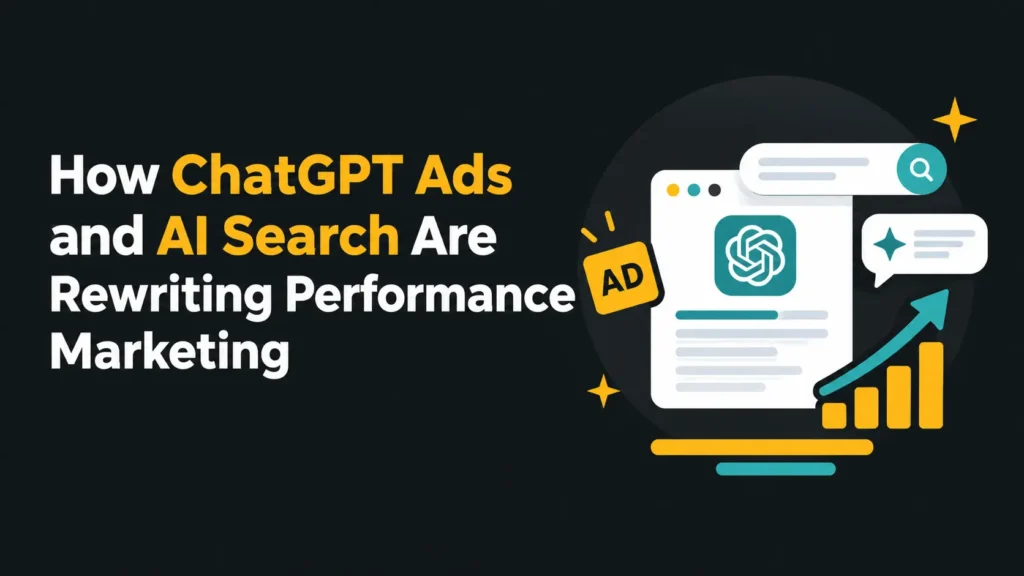
The short version: AI answers are eating clicks, and ChatGPT ads are a real, fast-growing paid channel that’s still unproven on performance. Fix your measurement first, test with a small budget, and stop thinking in one step. Think in three: get cited, get clicked, get converted.
Let’s be honest: the click has been the hero of every performance dashboard we’ve ever built. Someone searches, sees an ad, clicks, buys. Clean, trackable, easy to put on a slide.
That tidy story is getting messy. Search engines now answer questions right on the results page, and a brand-new ad channel, ChatGPT, has gone from announcement to dozens of markets in under a year. So what does that mean for your budget? Let’s walk through it. (New to all this? My digital marketing fundamentals guide covers the basics first.)
Are AI answers really killing clicks?
Partly, yes, especially on informational searches. At Google I/O in May, Google said AI Mode has passed one billion monthly users and AI Overviews reach 2.5 billion. And studies from Seer Interactive, SISTRIX and Ahrefs, summarized by Search Engine Land in April, found that when an AI Overview shows up, organic click-through falls by close to 60%. Paid click-through on informational queries drops by about 68%.
Does that mean search is dead? No. Transactional searches behave differently from “how do I…” searches. But here’s the catch: more of the influence now happens inside the answer, and last-click reports can’t see it. I looked at the early version of this shift in my post on Google’s Project Magi and what AI-powered search means for SEO, paid ads and jobs, and it has moved fast since.
What’s actually happening with ChatGPT ads?
OpenAI went from a US test to a conversion-based ad platform in under a year. Here’s the quick timeline:
- February 2026: a US pilot starts, with ads shown to Free and Go plan users.
- May: a self-serve Ads Manager opens in beta with no minimum spend, plus a pixel and Conversions API for tracking.
- June to September: conversion-optimized bidding rolls out, and reportedly reaches general availability in September.
- August: ads expand to 31 European markets, sold first through OpenAI’s ads team and agency and technology partners, with self-serve to follow.
According to OpenAI’s own announcement, advertisers can now buy ads through partners or the self-serve Ads Manager, and ads are kept separate from ChatGPT’s answers. OpenAI also says advertisers never see users’ conversations. And advertisers are piling in: Adthena data cited by Digiday shows brands advertising on ChatGPT across the US, UK, EU and Australia jumped from 1,082 in June to 6,333 by August.
Do ChatGPT ads actually perform?
Too early to say, and the evidence points both ways. Start with the sceptical side. Research cited by Digiday and summarized by eMarketer in early November compares paid ChatGPT visits with paid Google Search visits for US brands:
| Metric | Paid ChatGPT visits | Paid Google Search visits |
|---|---|---|
| Revenue per session | $0.89 | $2.45 |
| Conversion rate | 0.37% | 1.17% |
Advertisers in the pilot have also complained about irrelevant placements, low ad frequency, and thin reporting beyond impressions and clicks.
Now the optimistic side. Criteo, one of the pilot’s ad tech partners, reported in May that AI-referred conversion rates approached twice those of traditional search in several retail categories. And OpenAI’s own early benchmark for conversion bidding, relayed by IndexLab, claims a median 44% lower cost per result than click bidding across 27 advertisers. That’s self-reported, and 27 advertisers isn’t a big sample.
Here’s the fair read: both can be true. ChatGPT traffic can be high-intent in some verticals and still lose to Google in aggregate, especially on a young platform with immature targeting and measurement. Test it. Don’t move your budget into it.
How is Google responding?
By putting ads inside AI answers and building rails for AI-assisted checkout. If you run Performance Max, Shopping, or broad-match Search campaigns (including AI Max for Search), your ads can already show in AI Overviews and AI Mode. When these placements launched, you couldn’t separate their performance from other placements, so check what your own account reports today before you draw conclusions.
The bigger story is agentic shopping. In January, Google launched the Universal Commerce Protocol (UCP), an open standard built with partners including Shopify, Walmart, Stripe, Visa and Mastercard, so AI agents can carry a shopper from discovery to checkout. Google also added new Merchant Center attributes for conversational discovery and a Direct Offers pilot, which lets advertisers show exclusive offers to shoppers in AI Mode.
Translation: more of the buying journey can happen before, or without, a visit to your website. Your product data is now part of your ad performance.
So what should you do? Think Cited, Clicked, Converted
Stop measuring one thing and start measuring three.
- Cited: are AI answers mentioning or quoting your brand? This is the new top of the funnel, and no dashboard shows it by default.
- Clicked: is traffic arriving from AI surfaces and ads, and which analytics bucket is it landing in?
- Converted: what did it actually add? Someone might engage with an ad in ChatGPT and buy days later through organic or direct, so last-click will undercount it. Geo holdouts and lift tests show you the real contribution.
Then work through this list:
- Fix your tracking first. Both OpenAI and Google steer advertisers toward server-side signals. OpenAI reports its pixel plus Conversions API measured 57% more attributed conversions than the pixel alone (self-reported, via IndexLab). Even if you never buy a ChatGPT ad, server-side tracking with proper deduplication improves the data every platform optimizes on.
- Run a ring-fenced test. Set a small, fixed budget, pick one or two conversion events, and define success against your blended CAC or ROAS before you launch. Conversion bidding on ChatGPT needs at least five click-attributed conversions first, so plan for a learning phase.
- Clean up your product feed. Rich attributes, accurate pricing, accurate availability. Readiness for agentic shopping starts in Merchant Center, not with a toggle in Google Ads.
- Write to be quoted. Lead with the answer, use specific numbers with named sources, and keep sections self-contained. A peer-reviewed study (Aggarwal et al., KDD 2024) found that adding statistics, quotations and cited sources raised visibility in generative-engine answers by up to about 40%. This is what people call answer engine optimization (AEO). Want to see organic content work in practice? Browse my case studies.
- Write ad creative like a reply, not a billboard. A chat ad sits next to someone’s specific question. Lead with the problem they just asked about, and skip the generic slogan.
Want a second pair of eyes on your tracking setup or a ChatGPT ads test plan? Take a look at my performance marketing services.
Frequently asked questions
What are ChatGPT ads?
They’re labelled sponsored placements shown to users on ChatGPT’s Free and Go plans, kept separate from the chatbot’s answers. Advertisers can buy on a CPM or CPC basis, or optimize toward conversions, and track results with OpenAI’s pixel and Conversions API.
Do ChatGPT ads convert better than Google Ads?
Not on aggregate data so far. Research cited by Digiday found a 0.37% conversion rate for ChatGPT traffic versus 1.17% for Google, though Criteo’s data shows stronger results in some retail categories. Treat it as a test channel until measurement matures.
What is answer engine optimization (AEO)?
AEO means structuring your content so AI systems like ChatGPT and Google’s AI Overviews can quote it in their answers: direct answers up front, clear headings, specific statistics and named sources. It complements SEO rather than replacing it.
How do I measure whether ChatGPT ads work?
Set up OpenAI’s pixel and Conversions API with deduplication, then test incrementality with geo holdouts or lift tests. Last-click will undercount the channel, because people often convert days later through organic or direct traffic.
Should I move budget from Google to ChatGPT?
Not wholesale. Run a small, fixed test with a clear success metric such as blended CAC or ROAS, and only scale up if the incremental results justify it.
The bottom line
The click isn’t going away, but it’s no longer the only moment that matters. The marketers who do well over the next year will measure beyond last click, treat AI surfaces as test channels with real hypotheses, and make sure their data and content are ready to be chosen when an AI is doing the choosing.
So, which AI-driven channel are you testing first in Q1? If you’d like to talk it through, get in touch. I’ll keep this post updated as the numbers change.